•    
  • Language

How AI can improve truck maintenance in Aitik

Every year, over 40 million metric tons of ore are transported through the Aitik mine – a task that takes a heavy toll on the mining trucks’ beds. How can damage be detected in time and maintenance planned more effectively? In an ongoing project, we’re exploring how AI and computer vision can be part of the solution.

Truck unloading ore at the KID2 crusher at Boliden Aitik where cameras, computer vision and AI are monitoring the truck beds.

When discussing artificial intelligence, Rasmus Tammia, Head of Boliden Mines AI Program, always comes back to the same starting point: “It doesn’t start with AI. It starts with the problem.”

The AI program conducts research and development in industrial AI, with a focus on our core business. The aim is to investigate how the technology can contribute to improved production. Recent developments in hardware, software, and AI models have made it significantly easier to use AI in actual industrial operations.

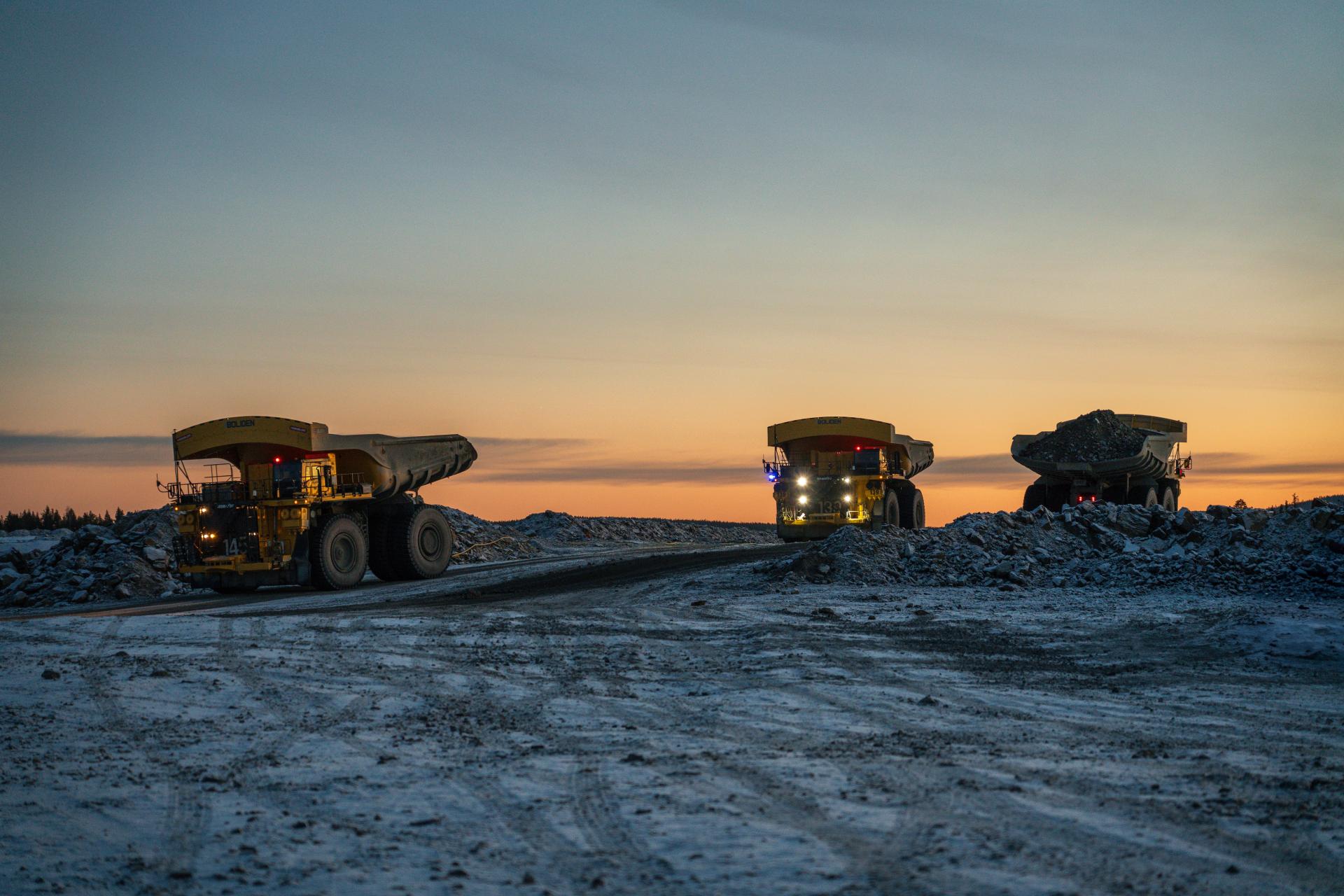
A concrete example can be found at the Aitik open-pit mine. Here, we extract 38–42 million metric tons of ore annually, which is then transported by large mining trucks to be crushed and concentrated. The enormous volumes take a heavy toll on the truck beds, where damage can lead to increased maintenance costs, equipment damage, and safety risks. 
 
To detect damage earlier and improve maintenance planning, we are now investigating how cameras, computer vision, and AI can be used to monitor the condition of the truck beds.
 

How can AI detect truck bed damage earlier?

For many years, truck beds at Aitik have been inspected manually or with drones. To better track how damage appears and develops over time, we installed a camera above the KID2 crusher in 2023, where the trucks unload their material. 

When a truck has unloaded, photos are taken automatically. The project is then being developed in stages: from collecting the right images and getting the technology to work in the demanding mining environment, to training the AI model to identify different types of damage.


Why AI was the right tool 

Photographing the truck beds is one thing. Being able to quickly interpret the images and determine what they show is another. This is where AI comes into play. 

By training models on image data, AI can learn to recognize and distinguish between different conditions and anomalies. The goal is for the technology to eventually be able to classify different types of damage on the truck beds. 

"Computer vision is already a mature AI application. The next step is to classify different types of damage: what are we actually seeing? Over time, this could become a service that alerts the truck repair shop when something needs attention", says Rasmus Tammia. 
 
AI is also used to filter out low-quality images. This allows maintenance staff to access more relevant information without having to manually review the entire image stream.


Keeping people at the center

Technology is only part of the solution. One of the biggest challenges in the project has been understanding what end users actually need in their daily work. That’s why the project is being developed and tested in close collaboration between Aitik’s IT, maintenance, and operations departments. 
 
"It’s about understanding the everyday problems end users face. We’re building these AI applications to support the operator. People are still at the center in one way or another", says Rasmus Tammia.


“If we see that a specific truck is beginning to show signs of wear, we can decide whether maintenance needs to be scheduled. That’s the kind of foresight we want to create,” says Rasmus Tammia.

Business Benefits

Detecting damage is not the goal in itself. The main benefit is improving the availability and utilization of the truck fleet, which directly affects production at Aitik. 

“If we see that a specific truck is beginning to show signs of wear, we can decide whether maintenance needs to be scheduled. That’s the kind of foresight we want to create,” says Rasmus Tammia.

By detecting and monitoring damage earlier, we can take a more proactive approach to maintenance and implement measures at the right time. At the same time, the goal is to reduce the risk of unplanned downtime.


Lessons for more AI projects

This is still a pilot and development project, where the value lies not only in the solution but also in the knowledge we’re building along the way. 
 
One key lesson is how much effort is required to make AI-based image analysis work in a real mining environment. Weather, lighting, and seasonal variations affect both cameras and images. That’s why we’ve tested different cameras and methods, which has also provided insights that can be applied to future outdoor AI projects.  
 
The work has also opened the door to new areas of application within the AI program. Among other things, this knowledge could be useful in future AI initiatives for mobile machines. For Rasmus Tammia, it’s about maintaining an open mindset toward rapid technological development and the opportunities it can create within the business. 
 
“It’s almost like an educational effort that can inspire more ideas. If we can do this, what else could we do?” he says.

The recipe for successful AI implementation

How do you introduce AI in a way that creates real value and earns trust? In this conversation, Rasmus Tammia, Head of Boliden Mines AI Program, and external AI expert Magnus Gens discuss the lessons learned from implementing AI in mining operations, and why successful adoption is driven as much by people and culture as by technology.

Related Content

Boliden and Thomas Concrete Group in deepened research collaboration

2025-04-08

Boliden and Thomas Concrete Group in deepened research collaboration

Boliden and Thomas Concrete Group have signed a long-term research and development agreement aimed at developing and optimizing an alternative binder for concrete, based on the SCMentum product concept developed by Boliden.

  • Innovation
  • Products
  • Production
  • Sustainability
Collaboration for e-waste circularity in telecom industry

2025-04-02

Collaboration for e-waste circularity in telecom industry

Boliden is collaborating with IVL Swedish Environmental Research Institute and Ericsson to enhance the visibility of circular electronic waste management in the telecom industry. Their joint efforts aim to accelerate the transformation of Swedish industry toward achieving net zero emissions. This initiative is supported by Sweden's innovation agency, Vinnova, as part of a Net Zero Industry Programme.

  • Innovation
  • Smelters
  • Sustainability
Boliden and Skanska collaborate for circular cement replacement

2025-03-11

Boliden and Skanska collaborate for circular cement replacement

Boliden is initiating a collaboration with Skanska Industrial Solutions aimed at developing the use of Boliden's cement replacement product (SCM), which largely consists of residual materials from Boliden's copper production, for applications in the construction industry.

  • Innovation
  • Production
  • Sustainability
Moving closer to fossil-free mining underground

2025-02-05

Moving closer to fossil-free mining underground

Leading the way toward the fossil-free mining of the future, Frida Pettersson is pioneering efforts 750 meters underground at the Kristineberg mine.

  • Automation
  • Innovation
  • Safety
Future of metal and mining: Boliden launches Low-Carbon Nickel

2024-03-19

Future of metal and mining: Boliden launches Low-Carbon Nickel

Boliden increases the Green Transition Metals portfolio launching Low-Carbon Nickel. The new product further boosts Boliden's collection of low-carbon offerings, joining current portfolio members Low-Carbon Zinc, Recycled Zinc, Low-Carbon Copper, Recycled Copper, Low-Carbon Lead, Recycled Lead & Low-Carbon Sulphuric Acid.

  • Innovation
  • Products
  • Sustainability
Our statement on our product CO2 footprint

2022-09-12

Our statement on our product CO2 footprint

The mining industry lacks a standardized measurement method for carbon dioxide emissions - our ambition is to change that.

  • Production
  • Sustainability
Climate smart transports

2019-03-20

Climate smart transports

Boliden is investing SEK 300 million in the expansion of electrified transport at the two open-pit mines of Aitik and Kevitsa, mainly during 2020-2021.

  • Production
  • Safety
  • Sustainability

Contact

Boliden Head Office

Boliden Group
Klarabergsviadukten 90
P.O. Box 44, SE-101 20 Stockholm
Tel: + 46 8 610 15 00
Fax: + 46 8 654 80 90